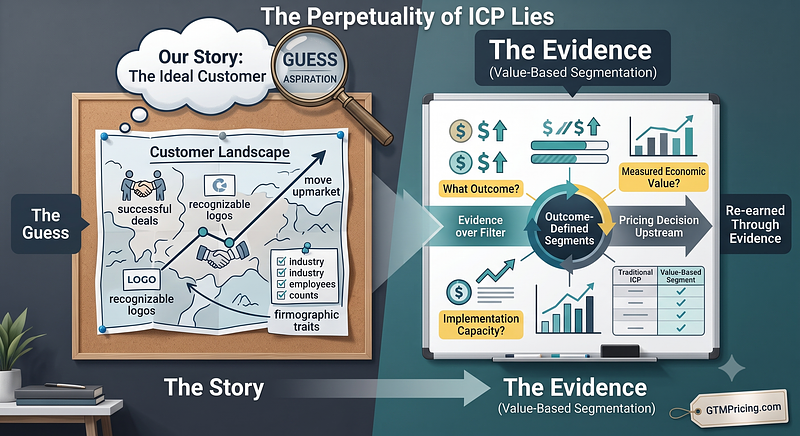
Most companies do not have an Ideal Customer Profile; rather, they have an internal story about who they want to win.The story sounds rational enough. It usually starts with a few successful deals, some recognizable logos, a handful of common firmographic traits, and a strategic ambition to move upmarket or sharpen focus. RevOps then turns that narrative into the cornerstone of their process. At that point, the story stops feeling like a hypothesis and starts feeling like truth.That becomes the perpetual lie of ICP. Markets shift, products mature, competitors reposition, and the customers who once represented your best fit quietly stop being your best fit. The revenue consequences show up in KPIs — in win rates plateau, expansion stalls. Overall NRR metrics suffer and usually everything gets blamed except the original targeting decision.The lie is not that companies should not define target customers. Indeed, they should. The lie is that once the profile is documented, aligned, and socialized, the ICP definition is treated as a fait accompli. In reality however most ICPs are part customer pattern, part aspiration, part internal politics, and part operational convenience. Very few are continuously re-earned through evidence.This matters more than most teams admit. A weak ICP does not merely distort targeting. It affects pricing strategy, packaging logic, win rates, onboarding burden, expansion potential, and the company’s broader understanding of where revenue should come from. Once a flawed premise is embedded into the commercial system, the business is no longer just making a bad assumption; that bad assumption gets compounded in scale.Value-Based Segmentation Replaces the Guess with EvidenceThe alternative is not a better firmographic filter to define your ICP. Lets shift to a differentiated segmentation logic entirely — one built on the value a customer actually derives, not the demographic box they happen to fit into.Value-based segmentation asks a sharper set of questions. What outcome is this customer trying to achieve, and can we measure it? How much economic value does our solution create relative to their cost of the status quo? How repeatable is that value across similar accounts? Does the customer have the internal conditions — urgency, sponsorship, implementation capacity — to actually capture the value we can create?Answering these questions requires evidence the CRM does not readily contain. It requires structured Voice of Customer work: interviews that surface how a prospect actually measures success, win-loss analysis that explains why comparable deals had different outcomes, and post-sale data that ties adoption and expansion back to the conditions present at the time of sale.Segments built this way look different from the traditional ICP model. Instead of definitions like "mid-market SaaS companies, 200 to 1,000 employees," a value-based segment reads more like: "companies facing a specific compliance deadline, with an executive sponsor already accountable for the outcome, who can quantify the cost of inaction in dollars." That is a profile you can price against, message against, and forecast against with real confidence — because it is defined by the conditions that produce value, not the demographics that happen to correlate with it, imperfectly, some of the time.The starting point is different. Begin by understanding the Voice of Customer, value evidence, and the commercial patterns that show where differentiated value is actually created and captured. Focusing on who simply who buys is not enough. Extend the understanding of who buys, to how they achieves value in a measurable and repeatable way, and can support a pricing model that creates trust rather than friction.Segmentation Is a Pricing Decision, Not Just a Targeting DecisionHere is what most GTM teams miss: segmentation and pricing are not sequential decisions. They are the same decision viewed from two angles.A segment is not truly "ideal" if it cannot support your pricing model. A customer who fits every firmographic criterion but cannot internally justify your price, or cannot connect your product to an outcome large enough to absorb that price, is not a good-fit customer, no matter what. Conversely, a segment that looks unremarkable on paper but consistently perceives outsized value relative to price will out-produce the "ideal" segment on every metric that matters: sales cycle, win rate, retention, expansion.This is why value-based segmentation has to sit upstream of pricing strategy, not downstream of it. Design pricing around a customer profile that was never validated against actual value realization, and you are pricing against a guess. Guesses do not scale. They just get more expensive to be wrong about.The Standard to Hold Your Segmentation To - 4 QuestionsA defensible customer segment should answer four questions with evidence, not assumptions: 1) Who repeatedly realizes measurable value from what we sell? 2) Who can absorb our pricing and still perceive strong economic upside? 3) Who can implement without extraordinary friction? 4) Who is most likely to retain, expand, and compound our growth efficiency over time?That standard is harder to meet than a firmographic filter. It requires ongoing Voice of Customer synthesis, not a one-time workshop. It requires connecting pre-sale signals to post-sale outcomes. It requires treating segmentation as a living hypothesis that gets re-tested.The companies that make this shift stop asking "who looks like our best customers?" and start asking "who creates and captures the most value with us, and how do we find more of them?" That second question is harder to answer. It is also the only one that predicts revenue.Execution is Our Core MetricGTM Pricing helps commercial teams turn understand the value they deliver and to continually validate the who value is created for and to measure it. Work with GTM Pricing to align your revenue operations, sales, and product leaders with a shared, value‑based language grounded in real customer outcomes.We deliver data-backed, operationalized strategies—not just theoretical advice. Our commitment is to ensure our recommendations are fully integrated through your Revenue Operations (RevOps) so that strategy actually sticks and scales.Want a clearer growth trajectory with predictable sustainable revenue? Let’s connect on LinkedIn! Contact me at GTM Pricing.Free Value Cycle DiagnosticGet a stage-by-stage read on your go-to-market motion with our Value Cycle Diagnostic, a five-minute, fifteen-question tool. Every question is answerable from lived experience. The output is a personalized radar chart showing where your motion is strongest, where it's breaking down, and what specifically to address first.Click Here to take GTMP's Value Cycle DiagnosticKaren Chiang, Founder, Managing Director, Strategy & InnovationsGTM Pricing Innovations Inc.