
Where Your Go-To-Market Motion Is Breaking Down
Edward A Wong•
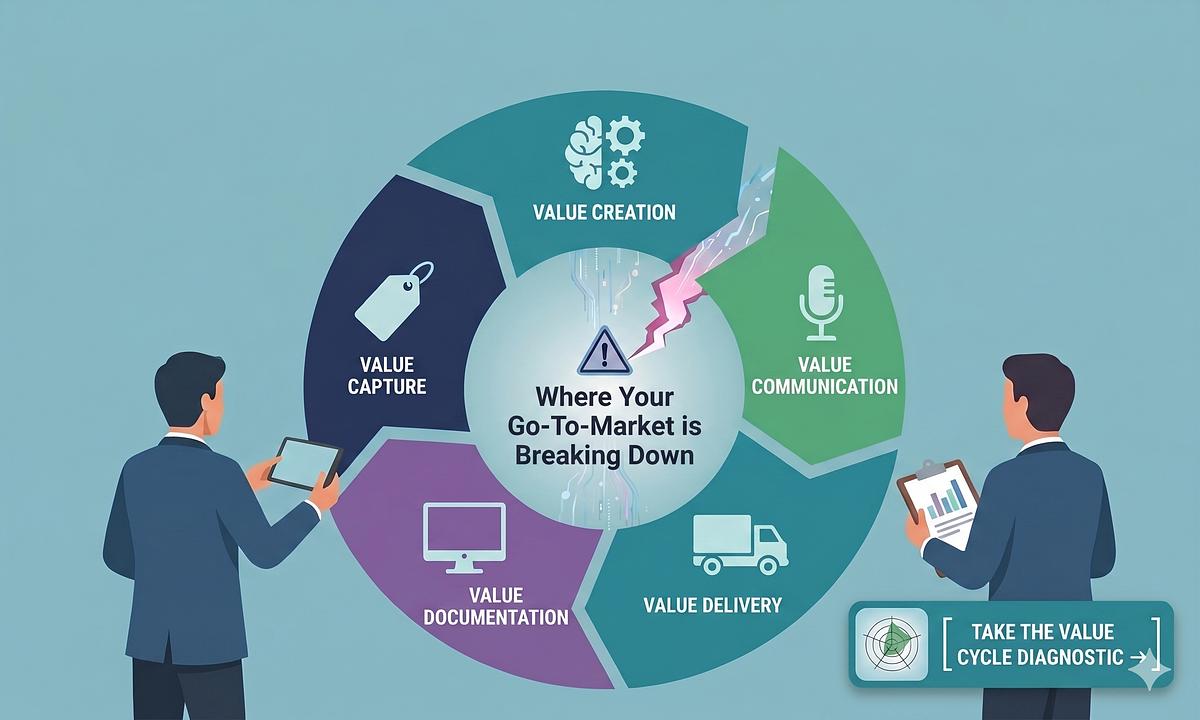
The Value Cycle: Where Your Go-To-Market Motion Is Breaking Down
Most B2B SaaS leaders aren't asking "what's wrong with our pricing?" or "what's wrong with our messaging?" They're asking harder, messier questions:
- Why is our win rate flat even as we add headcount?
- Why aren't customers expanding the way the model said they would?
- Why does our value story land differently depending on which rep delivers it?
- Why does pricing always come up as an objection — even when our product is clearly better?
These questions feel like separate problems. They aren't. They're symptoms of the same underlying issue: a break somewhere in the value cycle.
The Value Cycle is a complete loop
The Value Cycle is the framework that defines how organizations create, communicate, deliver, document, and capture value. It is not a linear funnel. It is a closed loop where each stage feeds the next, and weakness in any stage limits what every other stage can produce.
A company with a beautifully crafted value message can't sell on it if delivery doesn't follow through. A company with strong delivery can't capture fair pricing if the value isn't documented. A company with rigorous pricing can't sustain it if value isn't being created in the first place. The five stages connect — and the connections are where most B2B SaaS motions actually break.
The five stages:
.png)
Value Creation — understanding what outcomes customers actually value, across segments, and versus the alternatives they're really considering.
Value Communication — articulating that value to the right stakeholder at the right moment in the buying journey.
Value Delivery — consistently delivering on the value promise, and proactively managing gaps when they occur.
Value Documentation — systematically capturing and quantifying the value delivered, so it can be used in renewals and expansion.
Value Capture — translating value delivered into pricing that captures a fair share of the value created.
The interesting question isn't whether your company "does" each stage. Every B2B SaaS company does some version of all five. The question is which stage is the weakest — and what that weakness is costing you.
What weakness in each stage looks like
When Value Creation is weak, the company's value propositions are inherited from the founding team or pieced together from anecdotal customer conversations. Different reps describe the product's value differently. Segment-specific value drivers either don't exist or live in someone's head. The fix isn't more marketing — it's structured customer research that produces a defensible, segment-specific view of what customers actually value.
When Value Communication is weak, the same product gets pitched with the same deck to a $5M company and a $500M company. Win rates are inconsistent across reps because the message lives in the head of the best seller, not in a tested, documented framework. Buyers report that the value story didn't quite fit their situation. The fix is buyer-specific messaging grounded in research, validated through win/loss analysis, and reinforced consistently across the funnel.
When Value Delivery is weak, customers buy the promise but don't experience it consistently. Customer Success operates on usage and adoption metrics rather than business outcomes. Renewals come down to relationships rather than demonstrated value. Expansion stalls because customers can't articulate what they got from the original investment. The fix is operationalizing delivery — documented playbooks, outcome metrics tied to customer-specific commitments, and proactive intervention when accounts trend off-track.
When Value Documentation is weak, the company has plenty of customer success stories but very few quantified ones. Case studies are anecdotal. Sales decks reference "ROI" without being able to defend the number. Renewal conversations lean on relationship rather than evidence. The fix is building a structured value evidence base — quantified outcomes captured systematically, organized by segment, and actively used by sales, customer success, and pricing on every deal.
When Value Capture is weak, pricing was set thoughtfully at some point but hasn't been revisited as the product, market, or customer base has evolved. Reps default to list price minus a discount. Discount levels creep upward over time. ACV stagnates even as the product genuinely delivers more value than it did a year ago. The fix is value-based pricing that varies by segment, supported by ongoing willingness-to-pay testing, and updated as evidence accumulates.
Why the shape of the weakness matters
A company that scores low across all five stages has a fundamentally different problem than a company that scores well in four stages and badly in one. The first needs a foundational rebuild of its go-to-market motion. The second needs targeted intervention at a single point of the cycle — and the intervention will produce results faster, because the rest of the motion is already working.
This is why composite scores are misleading. Two companies with the same overall score can be in completely different situations. The shape of the weakness — which stages are strong, which are weak, and where the breaks fall — is what determines what to fix and in what order.
See where your motion is breaking
The Value Cycle Diagnostic is a five-minute, fifteen-question tool that produces a stage-by-stage read on your go-to-market motion. It doesn't ask for financial data. Every question is answerable from lived experience. The output is a personalized radar chart showing where your motion is strongest, where it's breaking down, and what specifically to address first.
Click Here to take GTMP's Value Cycle Diagnostic